





GOUSZ

JAMES SHIN

Building safe, intuitive, compliant, responsible, useful, and delightful products.

About Me ↓

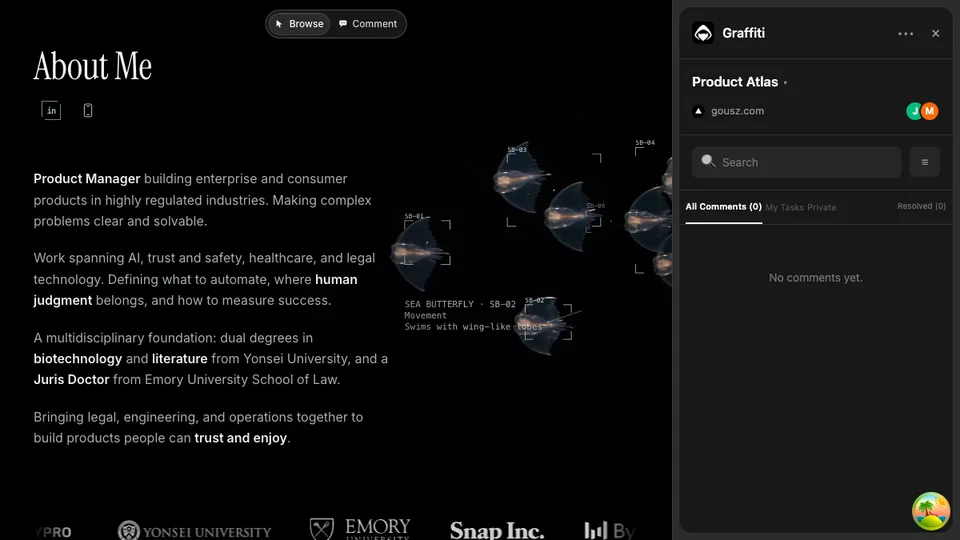
Sea butterflies are free-swimming marine snails that use wing-like flaps. Some make mucus nets for feeding, and their delicate shells are made of calcium carbonate.

About Me

Product Manager building enterprise and consumer products in highly regulated industries. Making complex problems clear and solvable.

Work spanning AI, trust and safety, compliance, healthcare, and legal technology. Defining what to automate, where human judgment belongs, and how to measure success.

A multidisciplinary foundation: dual degrees in biotechnology and literature from Yonsei University, and a Juris Doctor from Emory University School of Law.

Bringing cross-functional teams together to build products people can trust and enjoy.

  • Snap Inc.
  • ByteDance
  • InfinitusInfinitus
  • Apixio
  • Parley Pro
  • Yonsei University
  • Emory University
Product Stories ↓

Product Stories

AI Powered Triage

At Snap, I led product for an AI-powered platform to triage user data requests from law enforcement agencies worldwide. It streamlined initial review and delivered significant operational savings while preserving specialist oversight.

See moreSee less

The challenge

Requests arrived from different jurisdictions in varied formats. Reviewers had to reconcile information across documents and apply complex legal and policy requirements to determine whether and how to respond.

The opportunity was to reduce this preparation work while keeping consequential decisions informed, traceable, and accountable.

The approach

I started with the consequences of getting things wrong. Working across Legal, Policy, Operations, and Engineering, I assessed potential failure modes and distinguished readily correctable errors from those with serious downstream consequences.

That shaped the product’s scope, tolerance for error, and evaluation priorities. It also clarified what reviewers needed to verify before relying on an AI-generated result.

The platform extracted and organized information, linked it to supporting sources, and classified and routed requests. Specialists retained responsibility for legal validity, fulfillment, and disclosure. Connecting outputs to their sources made verification part of the review experience.

Evaluation and reviewer feedback informed refinement before and after launch, helping us assess usefulness alongside quality and identify where further improvements were needed.

The outcome

The platform substantially reduced manual triage work and delivered significant operational savings. Reviewers could spend less time assembling information and more time applying specialist judgment, with clear accountability for consequential decisions.

A Developer Platform for Child Safety

At ByteDance, my team and I built an internal developer platform that simplified child-safety integrations for teams launching generative AI features. The work made onboarding seamless and reduced the engineering effort needed on all sides to support new integrations and accelerate launches.

See moreSee less

The challenge

Different products brought different data sources, technical dependencies, and launch requirements. The challenge was making detection, moderation, escalation, and reporting easier to integrate while accommodating those differences.

The platform also needed to remain useful as products evolved, supporting both developers building integrations and the operational teams using the resulting workflows.

The approach

I turned recurring integration requirements into guided onboarding, clarifying what product teams needed to provide, which dependencies needed attention, and who owned each part of the process.

With engineering, we combined shared integration contracts with middleware that accommodated product-specific differences. Common requirements became reusable, while individual products retained the flexibility their systems needed.

Self-service did not mean unchecked. I placed deliberate gates for testing and verification along the path, so teams always knew where an integration stood, with an end-to-end QA pass confirming readiness before launch. The design considered the experience of both integrating developers and downstream operators.

I balanced ongoing launch commitments with investment in the platform, prioritizing work through business impact, technical readiness, and applicable regulatory requirements.

The outcome

The platform shortened onboarding, improved reliability and resilience, and lowered maintenance costs. Product teams gained a self-service path to launch, while engineering could spend less time on recurring integration work.

Voice AI for Healthcare Operations

At Infinitus, I owned a voice-AI platform for healthcare, supporting the mission of improving patient access to medication and treatment. My scope connected the live call experience, human intervention, and the tools specialists used to design conversations.

See moreSee less

The challenge

For prior authorizations and related workflows, an unfinished conversation could leave essential information uncollected.

Successful calls depended on several connected experiences: a conversation the recipient could follow, effective human guidance when the AI drifted, and carefully designed paths for gathering the right information.

The approach

I prioritized the interactions that determined whether a call could continue. The recipient experience led the roadmap, followed by the tools guides needed to intervene effectively when a conversation went off track.

We connected live call-quality monitoring with a workflow for prioritizing human attention. This helped guides identify struggling calls and focus their effort where intervention was needed. The product decision covered both recognizing a problem and making it actionable for the person helping resolve it.

Behind the calls, specialists used a dedicated authoring environment to build and refine scripts and decision trees. I owned that complete product workflow, balancing improvements to conversation design with the needs of recipients and guides during live calls. Research and operational analysis informed how we sequenced investment across the platform.

The outcome

The broader automation work reduced human handling time in healthcare administrative workflows, supported by a structured evaluation program.

Building Contract Intelligence

As Parley Pro’s first product hire, I worked with law firms and in-house legal teams to build AI-assisted contract review and workflow tools. My role spanned customer discovery, product delivery, and the data operations behind the product.

See moreSee less

The challenge

Legal teams needed help identifying contract risk and moving reviews forward. Building useful AI support required translating their needs into clear product workflows and consistently defined contract annotations.

The approach

I worked directly with customers and prospects to understand their problems, define use cases, and develop solutions through design sprints. With ML, Design, and Engineering, we shipped capabilities for contract review, risk identification, and workflow automation.

The data work was part of the product work. Working with the CEO, I created an annotation guide and labeled contracts alongside other law graduates.

That guide gave contributors a shared foundation for interpreting and labeling contracts. We established a process that later interns and editorial staff could continue as the product developed.

The outcome

We shipped contract-intelligence workflows and established an annotation operation the company could build on. Product recurring revenue grew during my tenure.

Parley Pro was acquired by LexisNexis.

Independent Projects ↓

Independent Projects